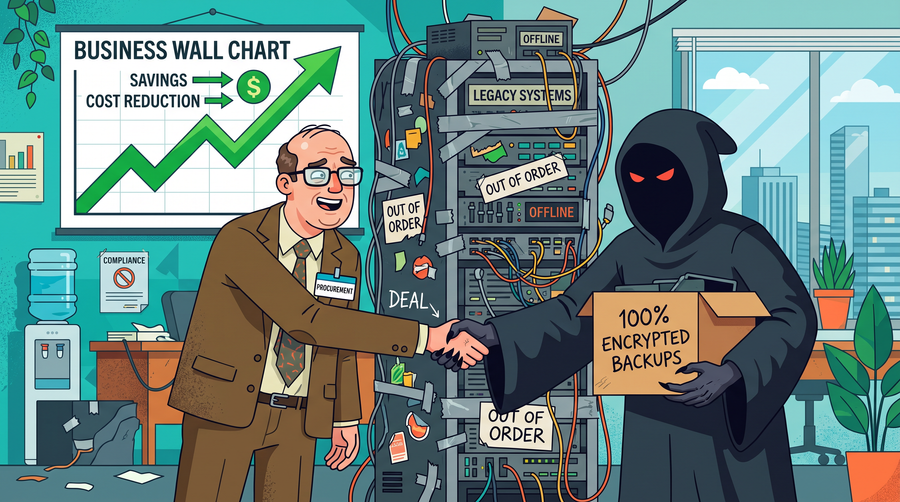
How I Finally Bypassed Procurement (and Saved the Company $800k)
I’ve spent the better part of two years shouting into the void. I asked for a firewall refresh; I got "we’re evaluating vendors." I asked for a patching window for the legacy SQL cluster; I got "downtime is not a KPI we support." I asked for a discovery tool to find all the shadow IT under Dave’s desk; I got "use an Excel sheet."
So, I’ve stopped fighting. I’ve decided to embrace the new corporate reality. If Procurement won't give me the budget to buy the tools I need, I’ll just let the "Global Community" do my job for me.
Welcome to the era of Project Ghost-Redundancy.
The Rise of the "Organic API"
For the non-technical managers reading this (I know you’re lurking), let’s talk about our new integration strategy: Organic APIs.
In the old days, we called these "unpatched critical vulnerabilities" or "RCE exploits." But since Procurement hasn't authorized the budget for the update cycles or the hardware to run the newer, secure versions of our OS, these holes have naturally evolved. They are "Organic" because they grew over time, nurtured by neglect and the slow decay of our infrastructure.
These aren't "security risks" anymore. They are frictionless, identity-agnostic entry points that allow external partners to interact with our data without the overhead of passwords, 2FA, or - my personal favorite - my permission.
The Ultimate P2P Sharded Backup
Yesterday, our Organic APIs finally reached peak maturity. A group of highly motivated "External Data Custodians" utilized these ports to implement the most comprehensive backup strategy I’ve ever seen: Global P2P Sharding.
Instead of storing our data on those aging, clicking hard drives I’ve been begging to replace, they’ve moved everything to a decentralized network of high-availability clusters across the globe. The data is now sharded, distributed, and stored on hardware that I don't have to maintain.
I’ve effectively achieved a 100% reduction in local storage needs. We are finally "Serverless" - mostly because the servers are now just expensive space heaters with empty databases.
The Bonus: Instant, High-Grade Encryption
Here is the best part: Management has been "considering" an encryption-at-rest project since 2022. It was always too expensive or too complex.
Well, our new partners have provided this service for free! They’ve applied a level of high-performance, mandatory encryption that is so robust even we can't get past it. This is the ultimate "Zero Trust" architecture. Our data is now so secure that it’s effectively invisible to everyone, including the people who are supposed to be using it.
We finally have the enterprise-grade security the Board keeps asking for, and we didn't have to spend a dime on software licenses to get it.
Superior Asset Discovery (The "Dave" Factor)
Here’s the kicker: These external partners are significantly more efficient than our own internal teams.
I’ve been begging for a budget to fix our monitoring gaps for years. Our "official" dashboard said we had 300 servers. Our new partners found 550.
- They found the legacy payroll DB from 2012.
- They found the three cloud storage buckets Marketing "forgot" about.
- They even found the dev environment Dave hid behind a rogue router in the breakroom.
Their discovery scripts didn't need a "Vendor Security Review" or a "Procurement Approval." They just worked. They mapped our entire digital footprint in 40 minutes... A task Management told me would take a "two-year roadmap."
The Financials: Why Incompetence is Profitable
I’ve prepared a cost-benefit analysis for the next Board meeting. Since we’ve bypassed the "Proper Way" (which Procurement blocked) and moved to the "Partner Way," the savings are astronomical.
Cost Analysis: Internal Implementation vs. Externalized RaaS
| Expense Item | The "Proper Way" (Rejected) | The "Partner Way" (Current) |
|---|---|---|
| New Storage/Equipment | $450,000 | $0 |
| Asset Discovery Software | $120,000 | $0 (Included in Breach) |
| Encryption Licensing | $60,000/yr | $0 (Provided by Partner) |
| Monitoring/Patching Labor | $180,000/yr | $0 (Not needed anymore) |
| Restoration Licensing Fee | $0 | $50,000 (One-time BTC) |
| TOTAL INITIAL COST | $810,000 | $50,000 |
Net Infrastructure Savings: $760,000
By simply being too slow to sign a purchase order, Procurement has saved us nearly a million dollars. We’ve traded a massive upfront spending bill for a small, one-time "Recovery-as-a-Service" fee.
Final Thoughts
To my fellow sysadmins: stop stressing about the security patches. Stop worrying about the fact that your firewall is old enough to vote.
Think of it as "Strategic Openness." The hackers aren't "stealing" your data; they’re providing a high-speed, automated, off-site, and fully encrypted backup service that your company was too cheap to build itself.
I’m currently watching the last of our customer records egress to a server in Vladivostok. It’s the fastest transfer rate I’ve seen in months. Procurement would be proud of the efficiency.
Current Mood: 🍵 Calm and drinking coffee.
Infrastructure Status: 100% Externalized.
Procurement Status: Still waiting for a quote on a 2024 firewall.
Note: This is no way reflects my actual job and is just a satire article spawning from a joke between friends.

Comments